
Frog News Signup

Save The Frogs Day: April 28th, 2012

Join SAVE THE FROGS!

Poetry Contest

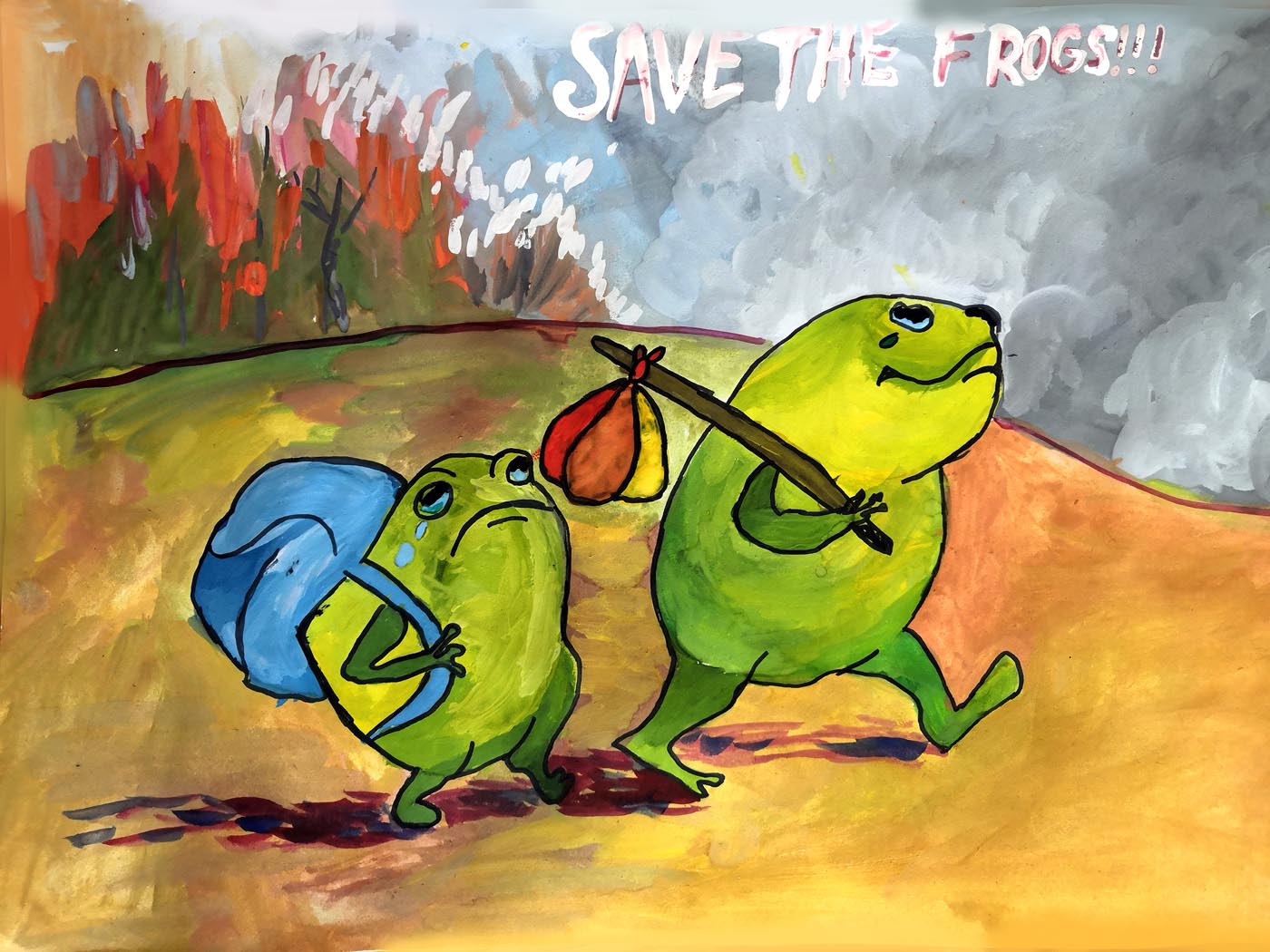
Art Contest

Dissections

Frog Legs

Roadkill

Atrazine

Sharp Park Wetlands

Antonelli Pond

STF! Ghana

South Korea

Wish List

Build A Frog Pond Contest

Awards

Teachers for Frogs

Students for Frogs

Businesses for Frogs

Scientists for Frogs

Politicians for Frogs

Testimonials

In The News

Take Action!

Audio

Volunteer

The FrogBlog

Frog Photos

Our Story

SAVE THE FROGS! Platinum Visa Card

Newsletters

Belize

Relevant Links

Advertise On This Site

Frog Jobs

Contact

Frog Shirt


Habitat Destruction | Pollution & Pesticides | Climate Change | Invasive Species  | Over-Harvesting | Infectious Diseases

Climate Change & Global Warming

Climate Change in Tropical Regions
Climate Change in Temperate Regions
Reduce Your Carbon Footprint
Frogs in Airports!

Introduction

Pseudacris maculata pond dryingUnlike reptiles or birds, which have hard-shelled eggs, amphibians have jelly-like, unshelled eggs that cannot survive desiccation. Amphibians need moist climates to reproduce, and this makes them extremely sensitive to climate change. Frogs in high mountainous areas are most affected by global warming. The climate change debate always seems to focus on the potential harm that may happen in the future if we don't act now. We need to make sure people know that climate change is ALREADY causing huge problems for the frogs!

Climate Change in Tropical Regions

Global warmingIn many areas of the world, especially in the tropics, mountainous areas have extremely high amphibian biodiversity. For instance, some sites in the mountains of Costa Rica and Panama may have up to 60 species. In these tropical montane areas, many of the amphibians live in cloud forests, and lay their eggs in the moist leaf-litter. As the eggs are laid away from water bodies, the embryos bypass the aquatic tadpole stage and hatch directly into tiny froglets. These 'direct-developing' species (like the Marsupial Frog Assa darlingtoni pictured here) are under serious threat from global warming, which acts to raise the cloud levels. If the cloud's average elevation increases a few hundred meters, the frogs at the newly-exposed lower elevations lose their habitat (and their lives) as the soil dries.

Climate changeWhile the affected frogs could potentially move up the mountain to find cool, moist habitat, many frog species already live at the tops of mountains, so when their habitat dries or warms, they have nowhere left to go. Another issue is that mountains are shaped like cones, and at a given elevation, there is less total area at higher elevations, so an amphibian that is forced to higher elevations would find itself in potentially crowded conditions. Further, some frog species live only on a single mountain range, or even on a single mountain, so when problems arise they are extremely prone to extinction. In Guatemala, several salamander species have completely disappeared as their cloud forest habitats have dried.

Climate change also affects host-parasite relationships. The deadly chytrid fungus (Batrachochytrium dendrobatidis) is expanding its elevational range in the high Andes of Peru as the glaciers melt and new lakes are formed. The fungus was recently found infecting Telmatobius frogs as high as 5348m elevation.

Climate Change in Temperate Regions

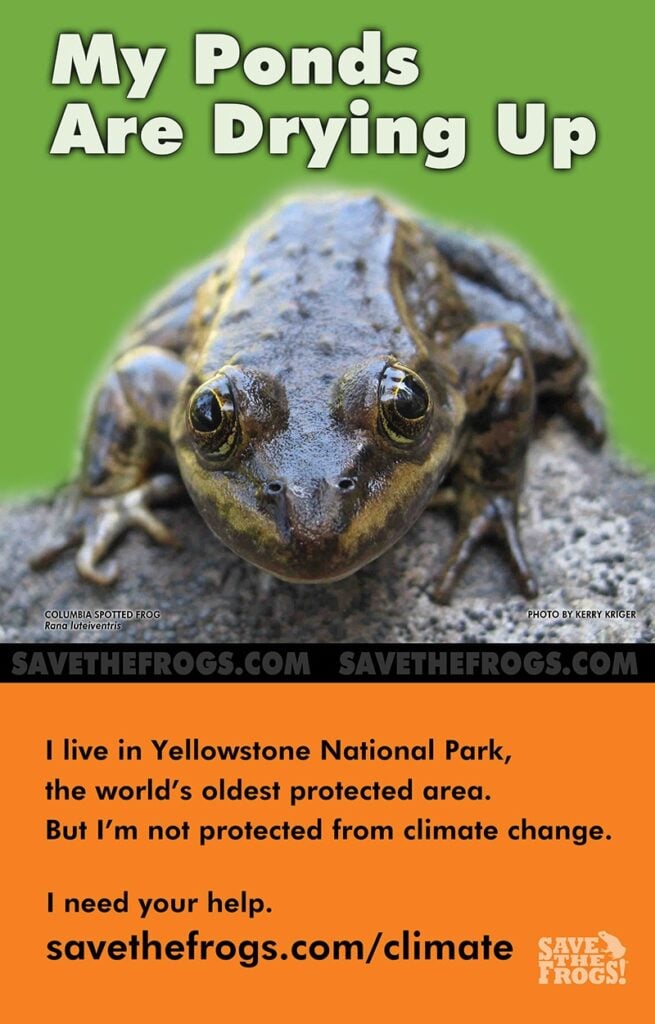
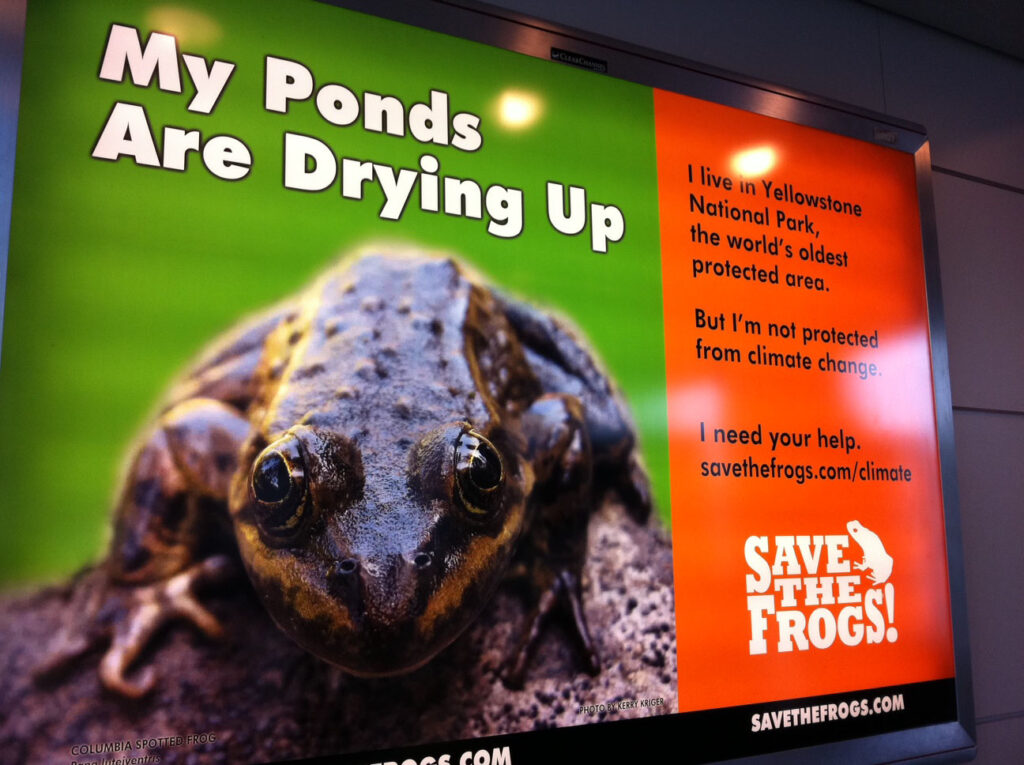
Yellowstone FrogsPond-breeding species are dependent on water bodies that do not dry up before their tadpoles can metamorphose. In Yellowstone National Park, droughts have been increasing over the last 50 years, and 25% of the ponds that existed in the early 1990's no longer fill with water. As the four amphibian species in the park are pond-breeders, it is not surprising that three of the four species are thought to now be declining in numbers, such as the Columbia Spotted Frog (Rana luteiventris) pictured here. Learn more about climate change in Yellowstone here.

Yellowstone is the world's oldest protected area, having been preserved as a National park since 1872, so if climate change is already affecting the park's wildlife, we have to assume that climate change is having an even more significant effect elsewhere in the world, where habitat destruction, pollution and pesticides, and over-harvesting are likely to compound matters.

In the United Kingdom, warm years stunt the growth of Common Toads (Bufo bufo) in the United Kingdom. In warm years, females were thinner, laid fewer eggs, and had reduced survival rates. Read more in this article by C.J. Reading.

Climate Comic by Joel Pett

Climate Change and Santa Cruz Long-Toed Salamanders

One of the western hemisphere's most endangered amphibians, the Santa Cruz Long-Toed Salamander (Ambystoma macrodactylum croceum) is endemic to a small section of coastal California not far southeast of the city of Santa Cruz, home of SAVE THE FROGS! World Headquarters. Only 23 populations of the salamander are known to exist.

"I am also working on the long-toed salamander; as fog disappears it will vanish. This is a certainty. It relies on summer fog to come out and forage at night even in summer. I am instrumenting the area with fog collectors to figure out how much fog there is, whether it is decreasing (a paper by a colleague Todd Dawson suggests this might be so). Thus, this is huge priority for me. I am also working with climate scientists to predict changes in fog into the future."
--Dr. Barry Sinervo; Professor of Ecology and Evolutionary Biology, University of California, Santa Cruz, CA


Eight ways to reduce your carbon footprint

While governmental action is an integral part of stopping global warming, every one of us is responsible for reducing our own carbon footprint. Here are eight easy ways you can do your part:

Turn off the lights

If you're not in the room (or the house), you probably don't need the lights on. Same with your office-place, and those lights in the parking lot. Try solar power for outside lights.

Don't purchase bottled water

Plan ahead and fill your re-usable bottle. Not only is plastic produced from oil, but it takes fuel to get that bottle of water from the source to the store at which you buy it.

Eat less meat

Cows live in pastures, which means rainforests worldwide are being destroyed to make way for cows. Without the rainforests to trap carbon, we don't stand much of a chance at fighting global warming. But that's not it: cows, pigs, sheep and goats are responsible for about 30% of America's methane emission -- and methane is far worse for the environment than carbon dioxide!

Take shorter showers

There is a high chance your hot water is being heated by electricity generated at a coal-fired power plant.

Don't fly first-class

Airplanes produce significant quantities of carbon emissions, and those spacious first-class seats take up 50% more space than do normal seats. That means you'e responsible for 50% more of that plane's carbon emissions than economy passengers.

Invest in environmentally-friendly businesses

If a company puts effort into improving their environmental practices, they likely have some information about it on their website. Do some research prior to investing, and then give your support to companies with positive environmental track records.

Drive less. Buy and rent smaller cars.

Eat at a restaurant closer to home, or stay home and eat. Get yourself a good book and try the local public transport sometime (it's probably improved since the last time you used it!). And next time you buy or rent a car, go with a fuel-efficient small car unless you have a true need for a large vehicle.


SAVE THE FROGS! in Airports

ClearChannel generously offered SAVE THE FROGS! free advertisement space in five major U.S. airports, and we got the Public Service Announcement seen below up in Chicago O'Hare International, Chicago Midway, Denver International, St. Louis and Detroit International Airports!. Some of these ad spots are huge...up to 7 feet high by 11 feet long (2.1m x 3.3m). Tens of thousands of people walk by these posters every day, and thousands visit savethefrogs.com for the first time after seeing the posters. Our O'Hare posters have been posted for nearly two years! Thanks to all those who helped us pay the printing costs!

Frogs Climate
SAVE THE FROGS! in Chicago O'Hare International Airport! Photo by Karen Manasco.

Help spread the word: print this 8.5 x 11" flyer

Please print and post this flyer to help spread the word about the effect of climate change, and make sure that people realize climate change is a problem now -- not something to be dealt with in the future. Right click the image to download the PDF.
Note: you can order an 18x24" poster version of this flyer here.

Climate Change Frogs


Recommended Reading & Viewing

Please read this excellent article on climate change by Vice President Al Gore that appeared in the New York Times November 9th, 2008.

Watch this fabulous video on the relationship between beef and global warming; it features Bill Nye (the Science Guy).

Engineering a future for amphibians under climate change -- Shoo et al. 2011

Future climate change spells catastrophe for Blanchard’s cricket
frog
-- McCallum 2010

Linking global warming to amphibian declines through its effects
on female body condition and survivorship
-- Reading 2007

Climate Change and Yellowstone's Amphibians -- McMenamin 2008

Salamanders and Climate Change in Central America -- Rovito 2009

Climate Change and Amphibians -- Corn 2005

Recommended Listening

In 2010, Texas-based Valero Energy pumped millions of dollars into supporting California's Proposition 23, which if passed would have suspended legislation (AB 32) that requires significant reductions in greenhouse gases that cause global warming and climate change. That would have spelled disaster for the Arroyo Toads: less snowfall and higher summertime temperatures cause the toads’ ponds and streams to dry up…and no water means no toads. Turn up your speakers and watch this video to learn more. Enjoy!

Prop 23 Save The Frogs

Bill McKibben, 350.org speech

Not about frogs, but a good talk on climate!

What's 350?

Scientists say that 350 parts per million is the upper limit of carbon dioxide we can safely have in Earth's atmosphere. Right now we are around 390 parts per million -- and frogs are paying the price.

Rana luteiventris

"The monetary woes the world has experienced is because we borrowed against tomorrow and could not pay back. The rain forests are one of the great climate bastions and when they are gone nature will make us pay for it. Let there be wildernesses for my children and not waste lands"
-- Peter Tappscott, Biologist; Cape Town, South Africa

Learn about other threats to frogs

Habitat Destruction | Pollution & Pesticides | Climate Change | Invasive Species  | Over-Harvesting | Infectious Diseases