



Introduction
The rapid disappearance of amphibian populations in recent decades is undoubtedly the most tragic loss of biodiversity we have ever witnessed and is one of the most serious environmental issues of our time. Fixing a problem of this magnitude requires a collaborative effort on the part of scientists, politicians, educators, businesses and members of the media, as well as high-profile personalities such as actors and musicians, who can quickly influence public opinion and bring an obscure issue (such as amphibian declines) to the forefront of public consciousness. It also requires a concerted effort on the part of average citizens, all of whom have the ability to reduce their impact on the environment and exert their influence on elected officials and the businesses they choose to support.
Think about the purpose of their subsistence
Think about their relevance and make a difference
These poor little frogs are needed here
Let’s help them survive so they will still adhere
One day we’ll say to our descendants:
“These are the creatures you almost never see, but we saved them and here they are, beautiful and free.”
— Frog Poetry from the SAVE THE FROGS! Poetry Contest by Ryssa Mae Alarcon, 13
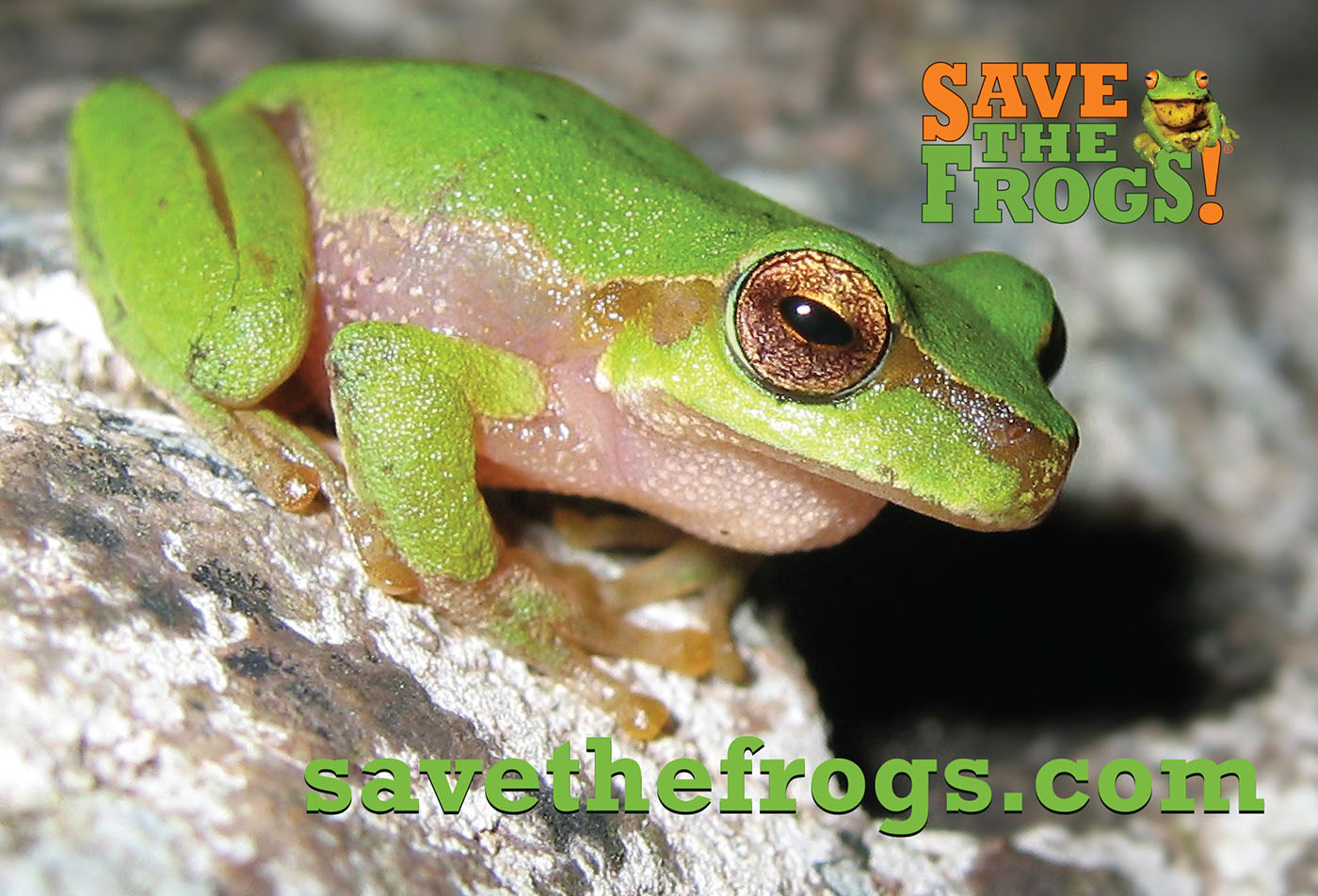
Cascade Treefrog (Litoria pearsoniana) from Springbrook National Park, Queensland, Australia, photographed by SAVE THE FROGS! Founder Dr. Kerry Kriger
Do NOT use pesticides!
Pesticides and herbicides are toxic chemicals that generally undergo little to no testing on amphibians prior to their being approved for use. Unfortunately, many of these pesticides end up in waterways, where amphibians live and breed. To make matters worse, amphibians have permeable skin that is highly absorbent.
For example, populations of the endangered mountain yellow-legged frog, (Rana muscosa), that live downwind of highly agricultural areas in California’s Central Valley have disappeared at a significantly higher rate than other populations.
Atrazine, perhaps the most commonly used herbicide on the planet (33 million kg are applied each year in the US alone), can cause hermaphroditism in frogs (males grow female sex organs) at ecologically relevant doses, and can reduce survivorship in salamanders. Atrazine also affects water quality in lakes, resulting in more snails. These snails serve as intermediary hosts of a trematode parasite that burrows into the developing limbs of tadpoles and causes limb malformations. Roundup (also sold as Touchdown Total) is lethal to gray treefrog and leopard frog tadpoles, and most likely a host of other as yet untested frog species. Roundup is a commonly applied herbicide in the USA; it’s produced by Monsanto, the same folks who gave us Agent Orange. Over half of the DNA found in frogs is also found in humans, so if these pesticides kill frogs, imagine what they do to us!
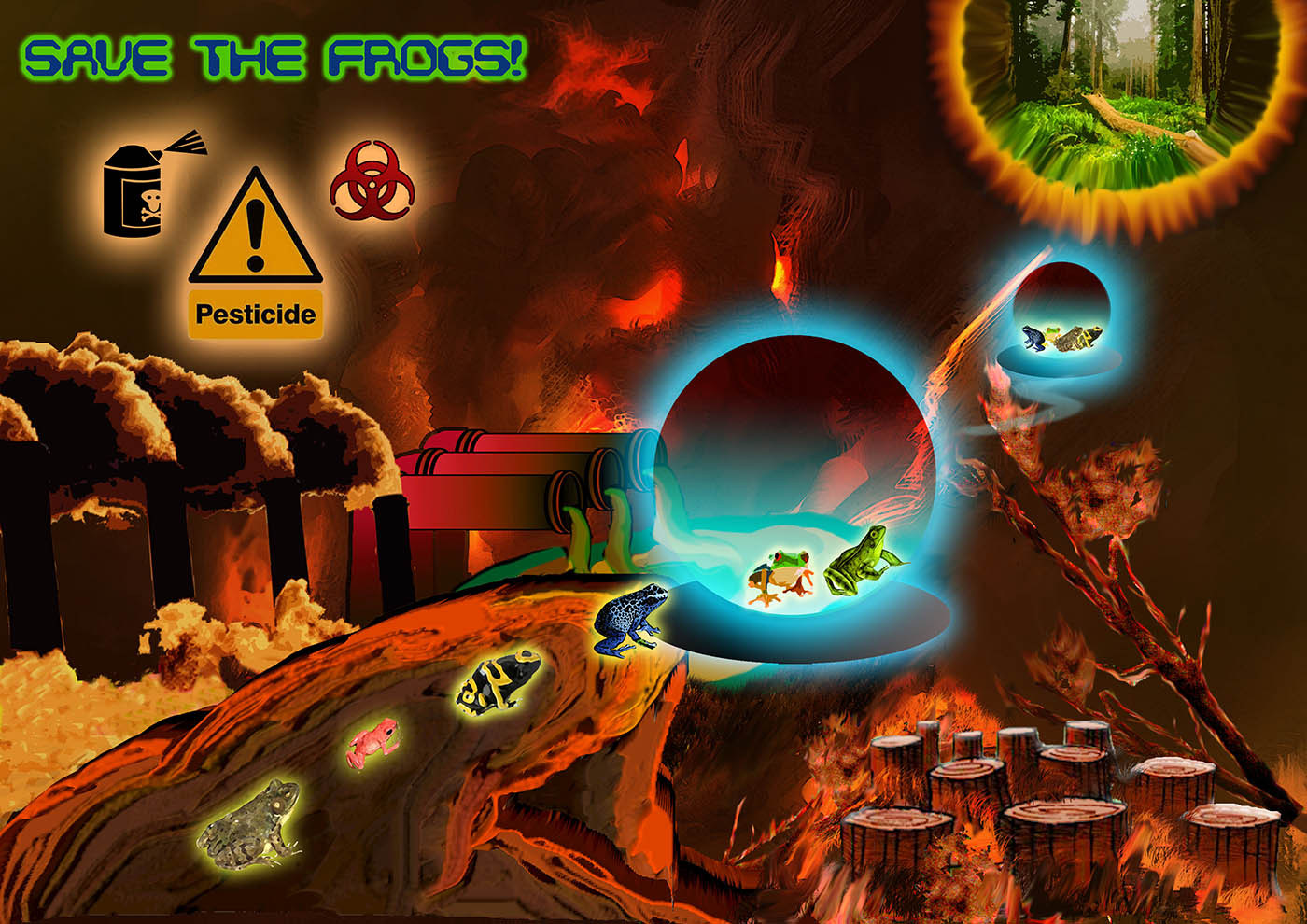
Art from India by Amritha Warrier, 2012 SAVE THE FROGS! Art Contest.
Frog Legs: don’t eat them!
Europeans alone consumed roughly 120 million frogs per year in the 1990’s, and currently between 100 – 400 million frogs are shipped internationally for food. The harvesting of amphibians for the food trade is often unregulated, and in many underdeveloped countries, such as Thailand, is likely a primary contributor to amphibian declines. Even in countries where the import/export of endangered species is controlled, there are virtually no protocols in place to ensure that diseased amphibians do not get transported.
Bullfrogs, (Rana catesbeiana), are commonly farmed and transported worldwide. They are known carriers of the amphibian chytrid fungus, (Batrachochytrium dendrobatidis), and thus are likely to be primary contributors to the global spread of chytridiomycosis, a disease that has decimated amphibian populations worldwide. In a recent study, 62% of the captive-raised bullfrogs sampled in shops in New York, Los Angeles and San Francisco were infected with the chytrid fungus! These three cities alone import over five million amphibians each year. Bullfrogs are also quite adept at establishing populations in areas to which they are introduced. They are large and compete with native amphibians for food and shelter, making them a harmful invasive species when they are outside their natural range (the eastern United States).
Do NOT purchase wild-caught amphibians
Over 20 million wild-caught amphibians are legally sold on the international market each year, and many more get sold either domestically or illegally. The wild amphibian trade is thus a significant contributor to amphibian declines and extinctions. If you plan to purchase an amphibian, ask your pet dealer for precise information on the origin of your potential pet. If the animal is wild-caught, or if the dealer is unsure on the origins of the animal, do NOT purchase it. Also verify that the species in question is not endangered. If the species you are interested in is listed as Vulnerable, Endangered, or Critically Endangered, do NOT purchase it. Never release a pet amphibian back into the wild unless it is being taken to its precise location of origin and has had a thorough disease diagnostic test (see next paragraph).
Further, we strongly suggest that the captive-raised amphibians you purchase were raised LOCALLY. When we transport amphibians around the world, we also inevitably transport amphibian pathogens. These pathogens eventually reach naive frog populations that have no evolved defenses against them, potentially resulting in lethal disease outbreaks. This is the precise reason chytridiomycosis has been able to decimate amphibian populations worldwide in so short a timeframe. Once a disease is set loose, it is virtually impossible to stop. Similarly, certain amphibians are quite adept at establishing populations far from their native range. Once this occurs they can predate on native frog species or out-compete them for food resources.
Summary: If you feel the need to have a pet amphibian, make sure it is captive-raised, preferably local, and even better -stick with native species.
Do NOT release your pet amphibian into the wild
Your pet frog may be begging you for freedom (just as you would be if you were held captive!), but unless you are taking it to the location of its birth, you should never set a captive frog wild. The frog may be a non-native species that could establish a population in your neighborhood, where it may eat native species or compete with them limited food resources. Alternatively, the frog may spread infectious diseases to a new frog population. The best thing to do if you have a pet frog you can no longer care for is to: (1) return the pet to the store from which you bought it; (2) donate it to a local school (informing them why you do not want to set it free); or (3) call up a local herpetological society to see if they would like to adopt your frog.
Toad on the road!
Amphibians like to take their time crossing the road…give them a brake! Roadkill is a significant cause of frog mortality in many parts of the world. There are at least 1.4 billion cars on the planet; if we conservatively estimate that each car kills only one frog every ten years, that would mean 1.4 billion frogs are killed by cars each decade. Wow! So drive slower on wet nights. Help a frog or toad cross the road (careful: don’t cause an accident or get squashed yourself). Some local frog groups organize events to help amphibians cross roads during the most active nights of the year. You can read more about the contribution of roadkill to amphibian declines on our Amphibian Roadkill webpage.
Do NOT stock non-native fish in your pond or stream
Fish are voracious predators of frog eggs, tadpoles and adult frogs. Introduced trout have decimated populations of the Mountain Yellow-legged Frog, (Rana muscosa), in California and the Spotted Treefrog, (Litoria spenceri), in south-eastern Australia. Both species are now on the verge of extinction. If your local government is stocking ponds and streams, make sure they are using only native fish species and only stocking areas that are meant to have fish (i.e. below waterfalls). If you are building a pond and want to support a healthy frog community, do not stock fish in it–even native species. Fishless ponds always tend to have a higher amphibian biodiversity than do ponds with fish.
Do NOT collect wild amphibians
Do not collect amphibians from the wild for use as pets, food, bait, laboratory, museum specimens or zoological display unless absolutely required for conservation purposes.
Picking up wild amphibians, even for a moment, can hurt them and spread disease.
Build a frog pond behind your home or school
What better way to get kids interested in frogs than to have them build a frog pond behind their school? Their efforts will be rewarded when they see the first clutch of eggs in the pond and when the first tadpoles metamorphose and crawl out of the pond! A backyard frog pond at your house is also a great way to give your local frog populations a boost. You can view pond building tips here.
Vote for the environment!
Recent years have demonstrated the potentially disastrous effects of environmentally unfriendly politicians. Such politicians repealed decades of hard-fought environmental regulations, jeopardizing ecosystem and human health. They subsidized wealthy businesses that pollute and destroy the environment, while failing to secure basic protections for endangered species.
If you are between 18 and 30 it is incredibly important to vote, as your age bracket consistently has the worst voter turnout, yet has the most to gain by voting. Please do your part: register to vote right now. Then research which candidate will be the most environmentally responsible. You can see how your current legislators have done by checking their environmental scorecard. Voting is a privilege, take advantage of it.
Do NOT dissect frogs
Frog dissections are unethical and unnecessary. Furthermore, they are contributing to the depletion of wild frog populations and the spread of harmful invasive species and infectious diseases. As excellent alternatives exist, SAVE THE FROGS! highly recommends that schools switch to virtual dissection software such as the Digital Frog (or there are many alternative online platforms too). We invite all students and teachers to assist worldwide amphibian conservation efforts by participating in our Race To Stop Dissections Contest.
Conserve Resources
Most of the products we use in our daily life, and even the things we take for granted (food, water, electricity) have been removed from their natural place in the environment. Given our current rate of consumption, there are simply not enough natural resources to support the Earth’s 7.6 billion people AND the other 20 million species on the planet.
We therefore offer the following suggestions on how you can reduce your ecological footprint: Turn off your air conditioning when it’s not in use. Tell you’re boss if your office place is too cold. Take a shorter shower. Put a lid on that pot of boiling water. Turn off your lights. Use compact-flourescent bulbs. Print on both sides of the sheet of paper. Turn your jacuzzi off when it’s not in use. Are you sure you need a bag with that? Drive a smaller car. Buy a hybrid if you can afford one. Ride a bus, or your bike. Walk. Actually, just sit at home and play some music. Going for a picnic? Don’t use styrofoam plates; most supermarkets sell biodegradable plates. Use a reusable water bottle and alternatives to single use plastic, like beeswax food wraps instead of cellophane and reusable grocery bags and ziplock bags.
Turn off the tap
Most municipal water supplies are diverting water from their natural locations. Frogs need these clean, natural water bodies to live and breed in. Did you know that neither the mighty Colorado River nor Australia’s massive Murray-Darling River system reaches the sea, because irrigation steals 100% of their water?
Hot water is also a source of environmental problems. The next time you’re shaving in the shower, think about the frogs that lived on the mountain in West Virginia that got strip mined to gather the coal that is being burnt into a black plume of smoke (that your children are breathing) in order to provide the electricity that is heating all the water that is going down the drain.
Drink tap water, not bottled water
Would you eat a $5000 meal at a restaurant? Probably not. Yet many people routinely spend 1000 times more for a bottle of water than the equivalent amount of water costs when it comes from the tap. Americans drank 42.6 billion bottles of water in 2015, the majority of which were NOT recycled. According to the Pacific Institute, the production of 30 billion plastic bottles requires the equivalent of 17 million barrels of oil (enough to fuel more than one million vehicles for a year!), produces more than 2.5 million tons of carbon dioxide, and uses three times the amount of water than ends up in the bottle. And these numbers don’t include the environmental cost of transporting the bottles from the factory to your local store. Interestingly, 25% of American bottled water (and 100% of Aquafina and Dasani) is just processed tap water that did NOT come from that fresh bubbly mountain spring you envisioned. Bottled water sold by Sam’s Club / Wal-Mart and Giant has been found to have contaminants above California’s legally acceptable limits.
Most municipal water supplies undergo stringent quality-control procedures, but if you are concerned about the health quality of your home water source, consider buying a PUR or Brita water filter. If you are leaving the house for the day, fill up a Klean Kanteen that you can re-use for years. The majority of western countries have free access to clean tap water. Take advantage of it.
In non-western countries there is virtually no recycling. Most plastic ends up being burnt in people’s backyards, creating toxic fumes and obvious health hazards. If you are headed to a country in which you do not plan to drink the tap water, we recommend purchasing a Katadyn portable water filter, or a portable Steri-pen UV-light. These products will save you money, allow you to drink the water in any situation and reduce your impact on the environment.
Reduce, re-use, recycle…in that order!
Reducing your consumption is the best. Attempt to re-use what you had to use. And if you have to dispose of it, try to recycle it. Yes, it is a slight inconvenience, but it is your responsibility…the products you use often come from the forest and contribute to habitat destruction, polluting the environment and global warming! Start a recycling program at your place of work if there is not one there already.
But remember, reduce your use first! In America, a lot of recycling is actually shipped to other countries, or contaminated and discarded. Many items you may think are recyclable actually are not (or it costs too much for companies to want to recycle it). According to the EPA, in 2017 only 8% of plastics in America got recycled.
Use rechargeable batteries
Approximately 15 billion batteries are produced worldwide each year. Batteries are packed full of toxic heavy metals (e.g. mercury, lead, cadmium, and nickel) that can cause limb malformities in frogs. Purchase rechargeable batteries. They will save you money and reduce your ecological footprint. And always recycle your batteries when you’re done with them, so that their toxins do not leach into the environment.
Become an amphibian biologist
Amphibian biology is a rewarding career that allows you to travel, work in beautiful places, help the environment and meet interesting people. There is a huge shortage of amphibian biologists in the world. More info on careers in amphibian biology can be found here. (Note to kids: amphibian conservation requires not only a love of animals, but also a firm grasp of mathematics and science, as well as effective communication and writing skills. Working hard in school now will greatly improve your future ability to be a successful amphibian biologist!)
Homeowners
Build a SMALLER house than your neighbor. Large houses require more natural resources to build, to furnish, to heat and to cool. Don’t chop down trees on your property: animals (including frogs) live in trees, and besides, trees look nice. Don’t mow your lawn so often. The emissions that come from lawn mowers are largely unregulated, which is why lawn mowers smell so bad! Or, better yet, if you have the space, allow wildflowers to grow in and provide wildlife habitat. Buy Energy Star appliances and have an energy audit done if you can afford one. Live in the desert? Go solar. Live on the water? Make sure you have a thick vegetated buffer to reduce erosion and provide wildlife habitat.
Educators
Schools must help to instill a love and knowledge of the environment in their students, and this begins at an early age. Please direct your students to this web site and give them a homework assignment on frogs. Make sure that your school system offers a strong environmental curriculum. Please see our Teachers for Frogs page for further information.
Investors
Some companies are environmentally responsible while others are environmentally destructive. Buy stocks in companies that help the environment. Avoid mutual funds that are indiscriminate about which companies they invest in, as their holdings likely include companies involved in mining, timber extraction, petroleum and pesticides. Does your mutual fund have holdings in Monsanto, one of the world’s largest producers of pesticides? Find out here. Consider purchasing a Green Century or New Alternatives fund.
Restaurant owners
Do you serve food to your customers on styrofoam or paper plates, with plastic cutlery, or give them their takeout items in a styrofoam box that’s placed inside a plastic bag? Did you know that all those materials are harmful to the environment, that virtually none of the waste will get recycled, and that the materials will not biodegrade for decades? Trellis Earth sells biodegradable versions of all these items. They’re made of corn and are fully re-usable, microwaveable. Plus they look a whole lot classier than plastic or styrofoam. Try EcoProducts as well.
Farmers
Frogs require healthy streamside habitats. If you have livestock, please fence off the vegetated sections of streams where frogs live, and restrict your livestock to specific portions of stream. This will reduce trampling of important frog breeding, feeding and living areas. If possible, fence off at least 30 meters (100 feet) on either side of the stream. Read our Farmers For Frogs page to learn more.
Pool Owners
Frogs like to swim in pools. If you own a pool and find dead frogs floating in it, you should consider buying a Critter Skimmer, which gives the frogs an easy way to escape your pool without drowning. The Critter Skimmer will help keep your pool clean, and save frogs. You can also try putting a few rubber black snakes around your pool to scare frogs away from the area. Please also put a cover on your pool to reduce evaporation; this will keep the water in the streams, where the frogs can use it (and keep frogs from drowning!).
Tadpoles in your pool? Here are our suggestions:
— Once discovered, the tadpoles should be released as close as possible to the pool site. If frogs are depositing eggs in the pool, then there must be a near by water source that they would naturally breed in. They could be released back into this water source, rather than take them across town. This way these tadpoles do not compete with tadpoles already at the new site; nor will they spread their diseases afar.
— If the tadpoles are metamorphosing, then they should be released in damp/shaded vegetation adjacent to the pool. If they are metamorphosing in the pool, then they should be able to get out on their own.
— If it is a maintained pool, then most likely the tads will not survive from the exposure to chemicals. However, if it is a pool that has algal growth in it…let them stay! Once they metamorphose, they will be able to crawl out. The pool should be checked for zooplankton (take a cup of water and look for little things swimming). If there is zooplankton, then this is a good indicator that the pool has become a pond type ecosystem…and most likely will support a small frog population.
— Frogs taken into captivity for a long period of time should NEVER be released back into the wild. There is a serious risk that once in captivity they have the potential to become exposed to diseases from the pet trade and/or get sick from the stress of captivity.
Watch what you eat
What does your food have to do with frogs? To begin with, millions of pounds of pesticides used on crops each year enter the waterways frogs depend on. Clearing rainforest for cattle ranching is perhaps the number one cause of deforestation in the Amazon. Add to that a burgeoning worldwide trade in frog legs, and it’s easy to see how our food consumption habits affect frogs.
SAVE THE FROGS! believes in the right to choose what you put in your mouth. That being said, the reality is that the production of certain foods wreak more havoc on the ecosystem than do others. Take beef, for instance: a single cow must consume vast quantities of plants before it is slaughtered, which means that all the energy, water and other resources used to produce and transport those plants are ultimately going to the production of a much smaller quantity of food. It has been estimated that producing a pound of beef requires 100 times more water than does producing an equal amount of wheat. Further, cattle ranching is dependent on open spaces, and this generally means large-scale deforestation, such as the slash-and-burn agriculture that is destroying vast tracts of the Amazon and Indonesia. Habitat destruction such as this is a primary factor contributing to global amphibian declines.
Even in areas with no natural forests, like the American Southwest, cattle and other ungulates (hoofed mammals: sheep, horses, goats, etc…) destroy land by trampling, resulting in erosion and land unsuited to other forms of agriculture. The massive amount of manure produced by cows and pigs fouls waterways used by frogs, and contributes a significant amount of harmful methane (a greenhouse gas that causes global warming) to the atmosphere. The US Environmental Protection Agency estimates that ruminant livestock (cows, sheep, goats, buffalo) produce 80 billion kg (176 billion pounds) of methane annually: 28% of the world’s human-related methane emissions! Finally, ranchers tend to have low regard for the value of large predatory animals: wolves, coyotes, jaguars, crocodiles, lions and bears are regularly killed in order to protect livestock…often with taxpayer-subsidized government assistance.
Reduce palm oil consumption and use
Palm oil is another environmental disaster. In the last decade it has started turning up in everything from your soap to your Milky Way candy bar. Check the ingredients before you buy something, and go palm oil free. Why? Rainforests throughout Costa Rica, Indonesia, Malaysia and other tropical countries are rapidly being destroyed in order to plant palm plantations, the oils of which then end up in products in your home.
Buy local
The average grocery store’s produce traveled 1,500 miles from the farm where it was grown to your refrigerator, resulting in significant carbon dioxide emissions that contribute to global warming, a primary threat to frogs. The main benefit of those stickers on your fruit (the ones that always end up by your favorite waterfall) is that they tell you where your food came from. Don’t buy an apple from the other side of the world if you can buy one from your own country, or better yet from the farmer down the road. Plus, locally produced foods are fresher and virtually always taste better
Shop In The SAVE THE FROGS! Gift Center
The SAVE THE FROGS! Gift Center is the best place for you to find frog-themed gifts that look great AND help us raise funds for our worldwide amphibian conservation efforts.
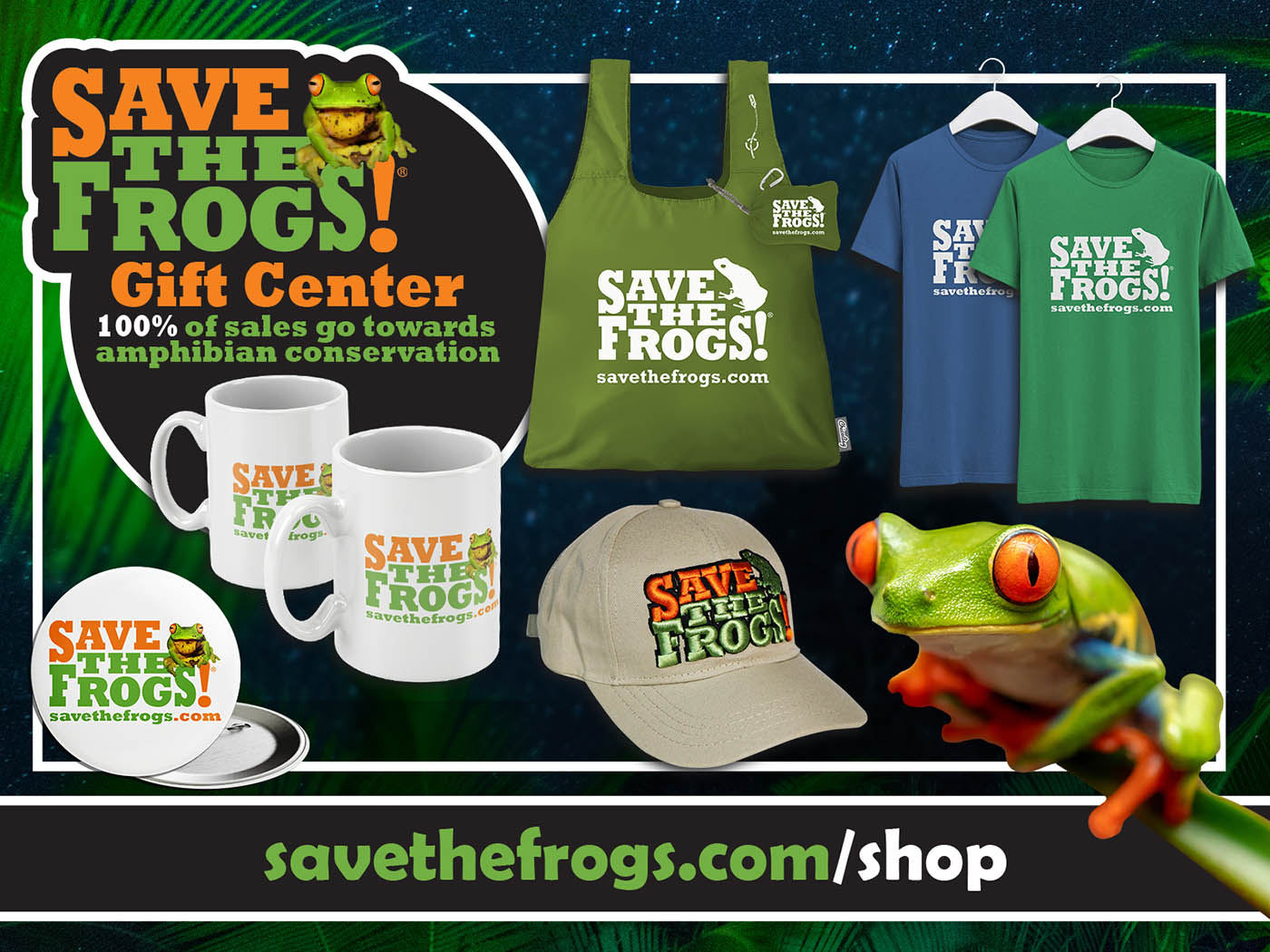
In the SAVE THE FROGS! Gift Center, you’ll find an array of frog-themed gifts, from shirts and tote bags to stickers, mugs and jewelry!
Know your frogs
Learn what frog species live in your backyard, your county, your state. Learn how to identify them both visually and by their calls. Many regional frog guides exist, as do CDs of frog calls. Walk down to your pond at night. Join a local frog group.
Spread the word! Add us on social media!
Nearly half of the world’s 8,000 amphibian species are in danger of extinction, and up to 200 species have completely disappeared in recent years. Unfortunately, only a very small proportion of our population is aware of this impending environmental catastrophe. This lack of awareness in the general public is one of the greatest impediments to successful amphibian conservation efforts. Think of how long it has taken for any political action on global warming to occur! Politicians rarely act until the public demands action. Our goal is to make the amphibian extinction crisis common knowledge through annual Save The Frogs Day. Add us on social media and tell your friends and members of the community about us!
Join your local ‘slow growth’ chapter
Frog species go extinct one population at a time. Urban sprawl destroys forests and drains swamps so that we can all have beautiful strip malls with fast food restaurants right next door. Many communities have organizations dedicated to sensible, responsible growth. Join one or start one. Call your local elected officials and tell them how you feel. Block the development of any proposed developments (strip mall, housing development, logging or mining operation, etc…) that threaten local wildlife populations.
Batrachologists
Please add your favorite photos to our photo gallery, and let us know if you have photos of extinct amphibians for our Extinct Amphibians of the World album. We’re also looking for 4+ minute recordings of frog choruses to stream from the site. We’d like a different chorus on every page. If you would like to submit content relevant to your area of expertise, please contact us. Alternatively, please add your thoughts to our FrogForum. Please add our logo and link to our site if you have a professional web page. If you know of any critical frog habitat that needs legal protection, let us know about it. And sign our batrachology petition!
Donate to SAVE THE FROGS!
We cannot exist without your support. Your donation will go directly towards SAVE THE FROGS! amphibian conservation efforts, which you can learn all about on our What We Do page and throughout this website.
We have a list of 100 things we could do to make it even better. Please donate so that we can employ a full-time (well-fed) webmaster to write educational content, get this site translated into as many languages as possible, and add tools to this site that will enable scientists and other conservationists to exchange ideas and communicate more effectively. We can make this site far better than it already is, but not without your support. Thanks!
Fundraise for SAVE THE FROGS!
SAVE THE FROGS! depends on the assistance of frog-loving people like you to help fund our worldwide amphibian conservation efforts. You can make a real-life impact by becoming a SAVE THE FROGS! fundraiser. Please visit our fundraising webpage, where we offer lots of ideas for you on how to raise money for the frogs. You can even create your own personalized fundraising webpage, or make a Team Fundraising Page for your school!
Make your company or organizations’ next social event a fund raiser. Fundraisers are also great ways to spread awareness amphibian declines. We can provide educational information to distribute. Contact us for more information and assistance in setting up your fundraiser.
Become a member of SAVE THE FROGS!
SAVE THE FROGS! is the world’s leading nonprofit organization dedicated exclusively to amphibian conservation. But SAVE THE FROGS! is not simply an organization. SAVE THE FROGS! is a movement. And it’s powered by people like you. Please join SAVE THE FROGS! today. On top of getting a great membership gift package, your financial support makes our worldwide amphibian conservation efforts possible. Thank you for becoming a member of SAVE THE FROGS!
Volunteer for SAVE THE FROGS!
If you are motivated and willing to help, please read through our Volunteers page, which will provide you with numerous ideas on how YOU can help SAVE THE FROGS!. Then join our worldwide community of volunteers, who are so vital to our worldwide movement!
Politicians
Politicians assume an incredible amount of responsibility–not just toward their constituents, but also towards protecting the environment. Proper legislation is needed to (1) protect crucial frog habitats; (2) regulate pesticide use; (3) oversee the trade of amphibians; (4) control global warming; (5) implement appropriate quarantine measures to ensure that imported amphibians are disease-free; and (6) ensure that amphibian conservation programs are sufficiently funded. If you are a politician, you are in an excellent position to SAVE THE FROGS!.
Lawyers
We are currently building an Amphibian Legal Defense Council so that we can challenge policies and proposals that harm amphibians. We are also seeking advice on nonprofit law, estate law, and trademark law. If you are willing to provide advice or volunteer some time, please see our Lawyers for Frogs page.
Business Executives
Business owners and managers assume an incredible amount of responsibility–not just toward their clients and employees, but also towards being environmentally and socially responsible. If you run a business, please install energy-efficient lighting and heating/cooling systems. And always consider the effect of your business practices on the environment.
Every corporation has an environmental impact: computers, equipment, water and electricity usage, wood or steel desks and chairs, building materials, employees driving to work, plastic packaging and the product itself. Yet the vast vast majority of companies donate $0 per year to environmental causes. Please ask your company’s executives to start a corporate environmental philanthropy program, thus offsetting the environmental harm caused by the company. Thanks!
Patagonia Inc.’s founder and owner Yvon Chouinard wrote an excellent book on how to manage a business that is both successful and environmentally friendly. Please also see our Business for Frogs page and find out ways to get your business certified ‘Frog-Friendly’.
Members of the media
The media is the general public’s primary source of information. Please consider writing an article or producing a TV or radio segment on amphibian declines. Contact us to set up an interview or discuss your idea, and please see our In The News page.
Students
Write an article on frogs for your school newspaper. Start a petition to get your school or university to stop allowing frog dissections to take place. Contact us if you want to start a Save The Frogs chapter at your school. Check out our Students for Frogs page. And tell your friends about us!
If you are you a motivated, independent and intelligent undergraduate, we have some projects in mind that would not only benefit SAVE THE FROGS! but would also impress your professor. Contact us.
Famous people
If you are famous (not just in your own mind!), you are in a perfect position to rapidly and effectively spread the message to the public, and help us raise money to SAVE THE FROGS! Please contact us to find out ways you can help.
Development Officers
It has been estimated that successful amphibian conservation will require $82 million per year worldwide. SAVE THE FROGS! doesn’t require that much, but we could certainly use your help improving our income stream! If you have fundraising experience, please contact us.
Website Developers
Want to help us improve our website? If you are highly skilled in MediaWiki, forms, scripts, CSS, SSL, shopping carts, multi-language websites, Facebook applications, video-game development, search engine optimization, or other aspects of web design/IT that may be of interest to us, please contact us. If you have a resume, please include it.
Want to make your own website more energy-efficient? Use a black background with white text, which saves about 20% (15 watts) of the monitor’s energy output. Did you know that if all 177 million American computer users reduced their monitor’s energy output by 20%, we could shut down 4 coal-fired power plants in Texas? Find out what coal combustion residues do to Southern Leopard Frog tadpoles in this interesting PDF. Read a thorough discussion on dark web pages here.
Upgrading to a new computer and wondering what to do with your old one? SAVE THE FROGS! is in search of high-quality laptops. Please contact us if you have a functional laptop that is 2006 or newer. We are a 501(c)(3) public charity so all donations are tax-deductible to the fullest extent of the law.
Our Wish List
Save The Frogs has created a Wish List of items we need. Have a look at the list, pick one that you think would be a great gift, and have it shipped directly to us! Thanks!
Donate your used car, boat, or RV to Save The Frogs!
SAVE THE FROGS! is in search of vehicles that can be used for purposes such as giving free public lectures on the amphibian extinction crisis, and conducting scientific research. While we use fuel-efficient vehicles for these purposes, we are seeking donations of ANY car, truck or RV, as we have partnered with a company that sells these vehicles at auctions or junkyards and donates a significant amount of the money earned to SAVE THE FROGS!. This company will pick up your used vehicle at any location in the United States, so please contact us if you would like to make a tax-deductible donation to SAVE THE FROGS! The process is simple and quick!
Link to our web site
If you have a website, a blog, a Facebook, Twitter or Instagram page, please add a link to our page: www.savethefrogs.com. You can use the logo on the right, or one of these pictures as the click through link to catch people’s attention:
Do you use email?
Yes, of course you do. A great way to spread the word is to add www.savethefrogs.com to the automated signature of every email you send. Just go to your mail options or settings and there should be a place to make an automated signature.
Sign up for the SAVE THE FROGS! mailing list
Want to keep up to date with all the latest frog news? Be sure to sign up for the free Save The Frogs newsletter.
Send us a suggestion
Have any ideas on how we can improve our web site or our organization? Please contact us.
Buy SAVE THE FROGS! merchandise
Your car would look way better with these bumper stickers. Wear a SAVE THE FROGS! T-shirt, wristband or pin.
Take part in our Frog Art, Frog Poetry and Frog Video Contests.
Take part, or even get your school involved.
Save The Frogs Day –
The annual Save the Frogs Day is April 28th Every Year. Please organize a Save The Frogs Day event in your community!
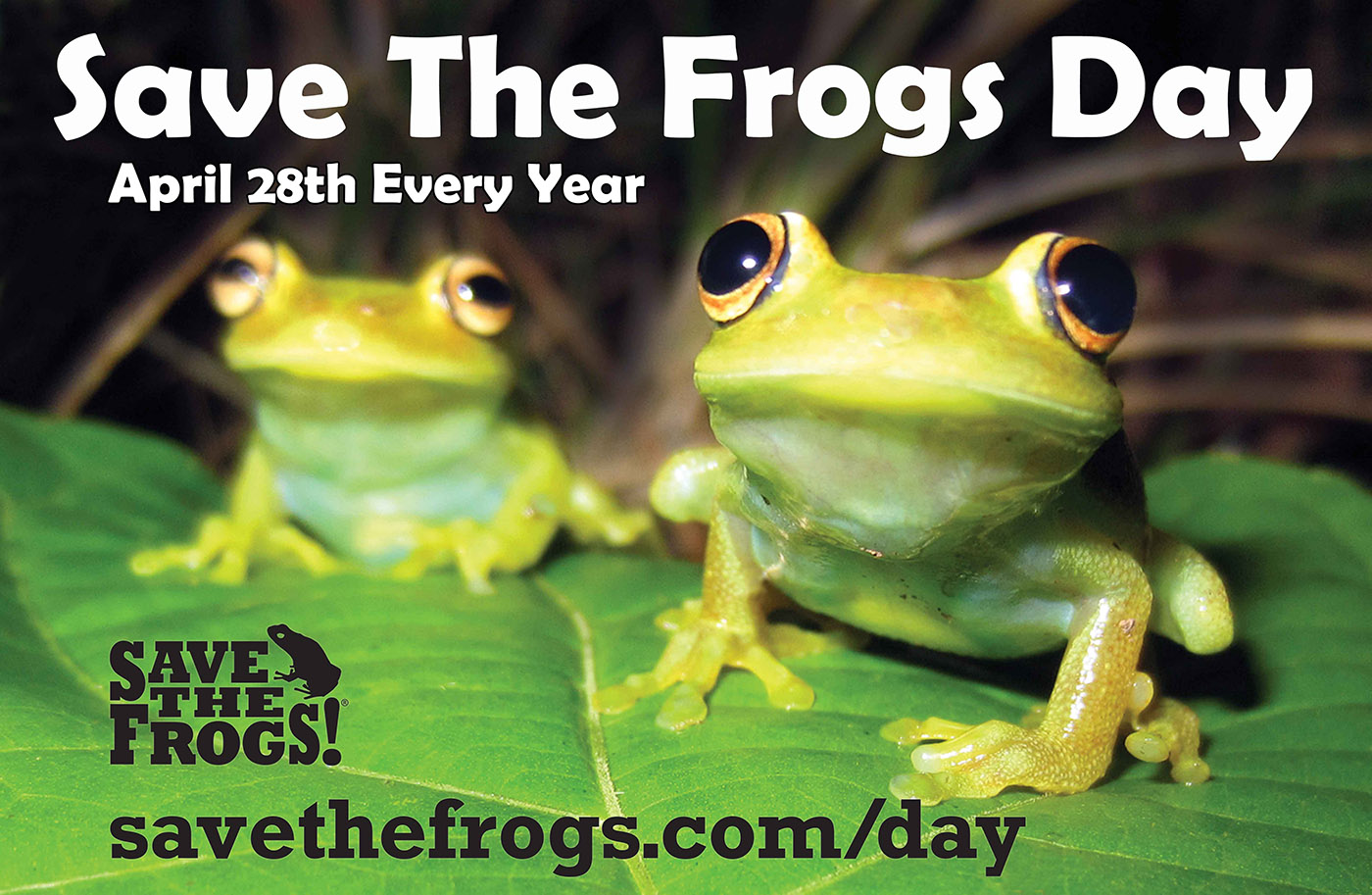
Attend one of our free lectures on the amphibian extinction crisis.
Learn more about amphibians and what we are doing to protect them by attending an upcoming SAVE THE FROGS! lecture.
Frog art from the 2021 SAVE THE FROGS! Art Contest by Anastasia Kadlubovich, Belarus
Post This Flyer Around Town!
Download the .jpg image or click on the image to get the downloadable PDF (23MB).
Post it at your school, in your office, at the supermarket, or in your favorite cafe.
Add the image to your website or favorite social media channel. Be sure to mention @savethefrogs and/or link to the https://savethefrogs.com website.
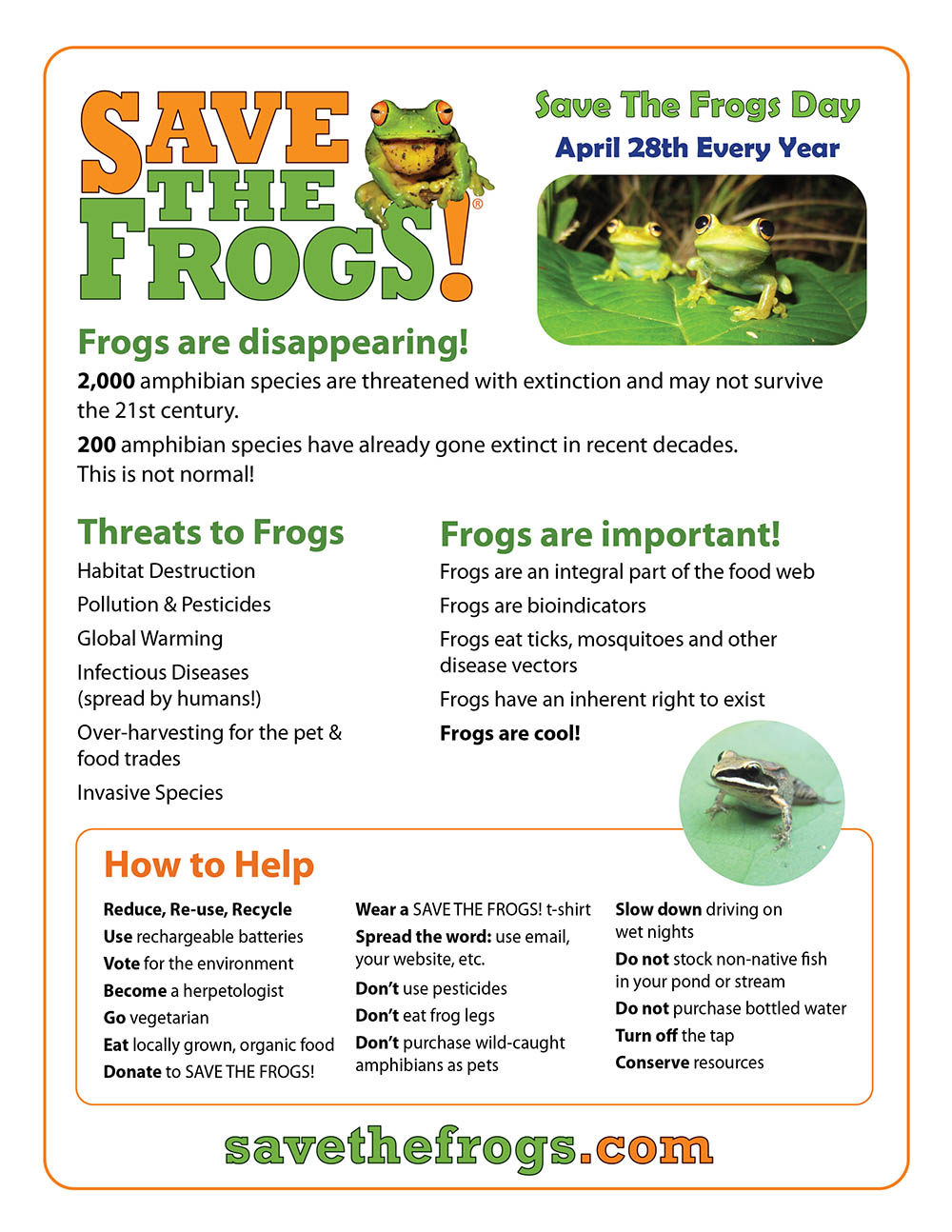
Thank you for spreading the word!